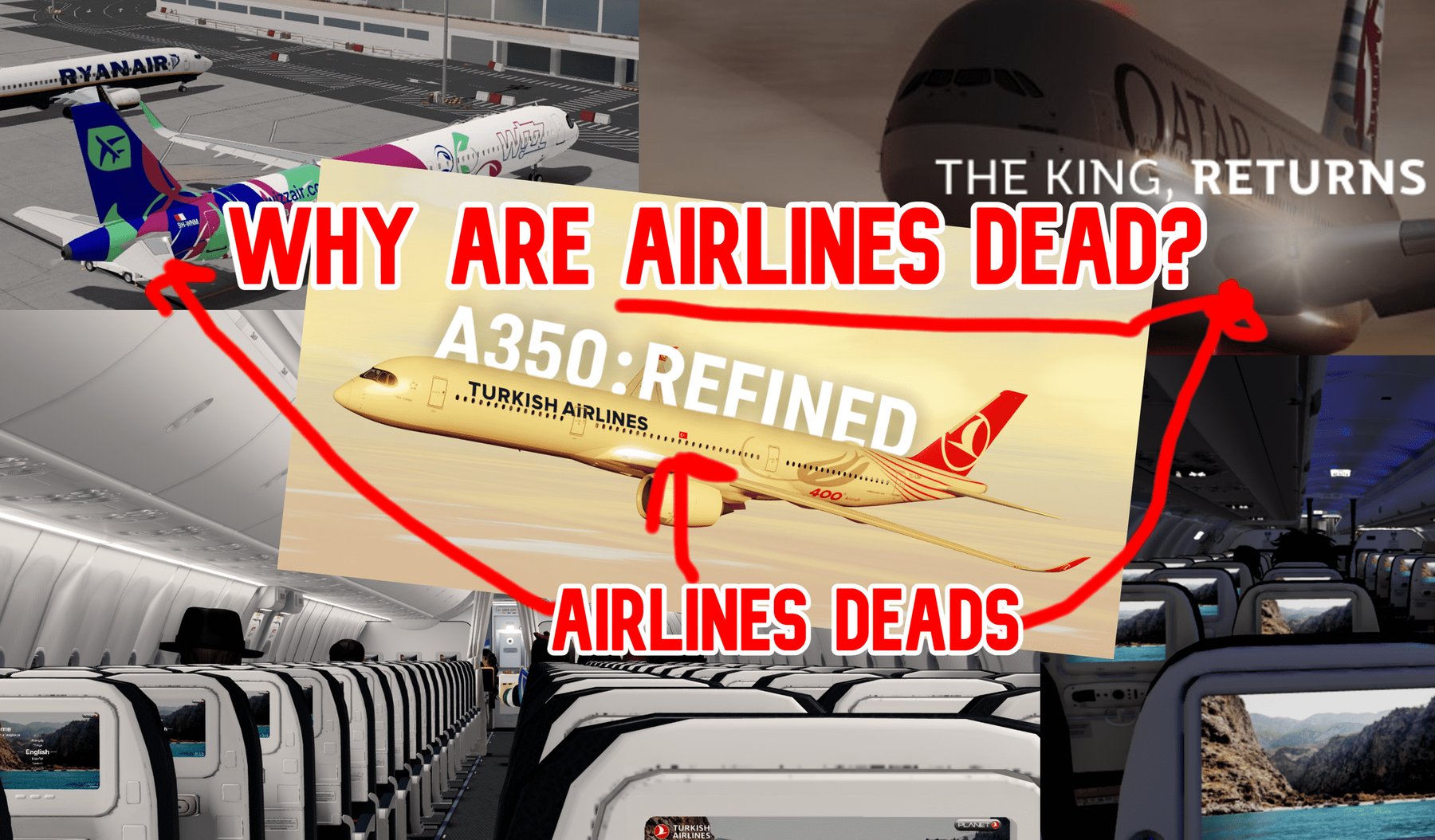
The RO-AV community has been going through a period of decline for approximately two years, and it seems to be showing no signs of slowing down. If things continue this way, we may see even more airlines and organizations completely abandon the community over the next few years.
But why? How is it possible that a community that remained active for so many years is now losing its activity, players, and appeal so noticeably? I don't have one single or completely clear answer. However, I have identified several factors that, in my opinion, are directly contributing to this situation. Here are some of the main reasons:
Free Resources and Their Overuse
Over the past two years, we have seen more and more people offering free resources: airports, assets, models, imports, and practically everything needed to create an airline. I completely understand that not everyone has the financial resources to invest in their projects. Offering free resources is not necessarily a bad thing. The problem begins when their overuse starts damaging the market itself.
The ease of obtaining practically everything has led to an explosion of airlines that, in many cases, lack identity, originality, or proper planning. Many projects end up using exactly the same resources, airports, and models. The result? An increasingly repetitive community where finding something genuinely different is becoming difficult.
In the past, when resources had greater commercial value, there was more activity between developers, buyers, and creators. There were stronger incentives to produce new models, innovate, and offer differentiated products. Today, much of that market seems to have lost its appeal.
The Gradual Disappearance of Developers
Another major problem is the loss of developers within RO-AV. Many creators who previously offered high-quality services have gradually abandoned the community or stopped offering their services. One of the reasons? A lack of demand and people willing to pay for quality work. This has caused many projects to increasingly depend on free resources or artificial intelligence tools to produce their content.
I am not against artificial intelligence. It is a useful tool that can be extremely helpful. However, relying exclusively on it without creativity, technical knowledge, or an original vision can result in repetitive and poorly differentiated products. If developers can no longer find opportunities to work, the market loses quality, variety, and the ability to innovate. And without developers, who is going to build the future of RO-AV?
Passenger Boredom and Loss of Interest
Perhaps one of the most concerning problems is the loss of interest among passengers themselves. Over the past two years, numerous airlines, both large and small, have experienced difficulties maintaining their communities and attracting passengers.
Even well-known airlines within RO-AV, such as Ryanair Roblox, Turkish Airlines, and Qatar Airways, have gone through different periods of changes, operational difficulties, and declining activity. We have also witnessed suspended operations, closures, and projects that have struggled to recover their former activity.
But what is causing passengers to lose interest? In my opinion, monotony. Many flights end up offering experiences that are far too similar. Passengers join, complete a flight, and find practically the same experience they could get from any other airline.
There is a lack of entertainment, originality, different experiences, and reasons to come back. An airline can have the best aircraft, the best airports, and a huge number of employees, but if its passengers stop finding reasons to participate, it will eventually lose activity.
Roblox Age Restrictions and RO-AV Market Prices
Roblox's age restrictions and verification requirements are also becoming a barrier for the community. Age verification systems and restrictions on access to certain experiences and features can make it difficult for many passengers to participate in airline flights, especially those who do not meet the platform's requirements.
Additionally, some airlines establish increasingly lengthy admission processes, involving forms, documentation, and additional requirements that can discourage people who simply want to enjoy a flight. On the other hand, the RO-AV resource market does not seem to be experiencing its best period either.
Some products are being sold at considerably high prices, even when their quality, originality, or level of innovation does not always justify the cost. The appearance of poorly developed assets, AI-generated products, and reused resources being sold at inflated prices does little to restore buyers' confidence.
If participating becomes increasingly complicated and creating an airline requires increasingly large investments, we are building barriers in a community that needs precisely the opposite: new participants.
The Increase in Drama and Controversies
Another factor that has considerably worn down the community is the increase in internal conflicts. Over the past few years, we have witnessed controversies, leaks, disputes between organizations, accusations, and situations that have ended up affecting projects that had been operating for years. One example is Skylink Airways, whose removal, together with its subsequent reopening attempts, has created considerable wear around the brand and its history.
After so many stages and changes, recovering the same trust, activity, and reputation it once had becomes difficult. The problem is not that conflicts exist, because no community is completely free of them. The real problem is when drama becomes a regular part of the RO-AV experience.
Many users simply want to enjoy virtual aviation, participate in flights, and be part of a community. They do not want to constantly encounter new controversies.
The Lack of Innovation and the Decline of Major Organizations
Where are the major brands that once drove RO-AV forward? Organizations such as Aeroware, Zerotech, and other brands that once stood out for producing aircraft, resources, and technology for Roblox have lost much of their presence or activity.
Projects that previously released new models, updates, and products now seem to have become inactive. This is particularly concerning because these organizations were not simply businesses within Roblox. They also contributed to the technological and creative development of the entire community. When the brands that once drove innovation stop producing, updating, and developing new projects, the entire ecosystem suffers.
We cannot expect RO-AV to evolve if those who once contributed to its development no longer have reasons to continue.
Superiority Complexes and the Obsession with Power
Finally, there is something I consider particularly damaging: the obsession some people have with achieving recognition, fame, and power within RO-AV. It seems that, for certain users, creating an airline, organization, or company is no longer about developing an interesting project. Instead, it becomes about proving that they are superior to everyone else.
Positions, ranks, reputation, and recognition are prioritized over the actual experience offered to passengers or the real quality of a project. Innovation should not be a constant competition to see who has the biggest airline, the most employees, or the greatest recognition. It should be a collective effort to improve the community.
As long as some people remain exclusively focused on their own prestige, building an environment where projects can collaborate, grow, and evolve together will remain difficult.
What Will Happen to the Future of RO-AV?
These are just some of the many reasons that, in my opinion, explain the decline of RO-AV. I do not believe there is only one cause, nor do I think every project is destined to disappear. There are still airlines, developers, organizations, and users keeping this community alive. However, it is difficult to ignore the changes we have witnessed over the past two years. Every time an important organization disappears, every time a developer leaves the market, and every time an airline loses its passengers, the community loses another part of what once made it special.
Historic projects such as Skylink Airways have demonstrated how difficult it can be to recover a position after going through multiple crises. Even organizations such as Qatar Airways, which once had a considerable presence, face the challenge of maintaining their activity and recovering part of their former community.
We also cannot ignore the emergence of airlines that automate much of their operations, further reducing the interaction and experience that traditionally characterized RO-AV flights. Are we approaching the end? Personally, I believe RO-AV will continue losing activity unless a major change takes place in the way its community operates.
We need developers, innovation, original projects, better passenger experiences, and, above all, collaboration between organizations. We do not need another hundred airlines offering exactly the same thing. We need projects that have something different to contribute. Perhaps one day RO-AV will disappear completely. Perhaps, in a few years, only a handful of independent airlines and small groups of players who still want to keep virtual aviation alive will remain.
I do not know when that will happen, or whether that moment will ever truly arrive.
But one thing is clear to me: A community does not disappear overnight. It begins to disappear when it stops evolving, when it loses its creators, and when its own members stop finding reasons to stay.
Long live RO-AV. And hopefully, we are still in time to save what little remains.